Bogotá, as discussed in our general post, is a sprawling city of around 10 million people. Cities of this size have incredible challenges when it comes to transportation and the movement of people. Bogotá is incredibly walkable despite being highly car-centric; and, of course, there are taxis and Ubers (which are technically illegal but still used by Bogotános). However, this city also features a bus rapid transit system (BRT) called TransMilenio, which is among the longest BRT systems on the planet. It has also achieved the highest capacity and highest speeds of any BRT system on earth. Since it opened in 2000, the BRT has seen its ridership climb: as of 2018 it was averaging 2.4 million riders on a weekday. Though it has its controversies, this exceptional BRT helped Bogotá win the Sustainable Transport Award from the Institute for Transportation & Development Policy in 2022. In fact, this is a system so well-regarded that it is studied in universities, including while I was in graduate school for urban and environmental planning. Moreover, the city used to rank among the most polluted and congested in the world, but TransMilenio has helped with that and it is easy to see why it has become the pride of the city.
What is a BRT? Well, in summary, think of a BRT as the bus-version of a light rail. These systems are faster and more efficient than traditional bus systems. For example, they segregate buses from non-bus traffic in specialized lanes to speed up routes, and allow passengers to pay at bus stations, often with a rechargeable card, to eliminate drivers having to deal with change. The very first BRT system was built in Curitiba, Brazil in the 1970s, and since then BRTs have spread across the world. They have become especially fashionable in Latin America.
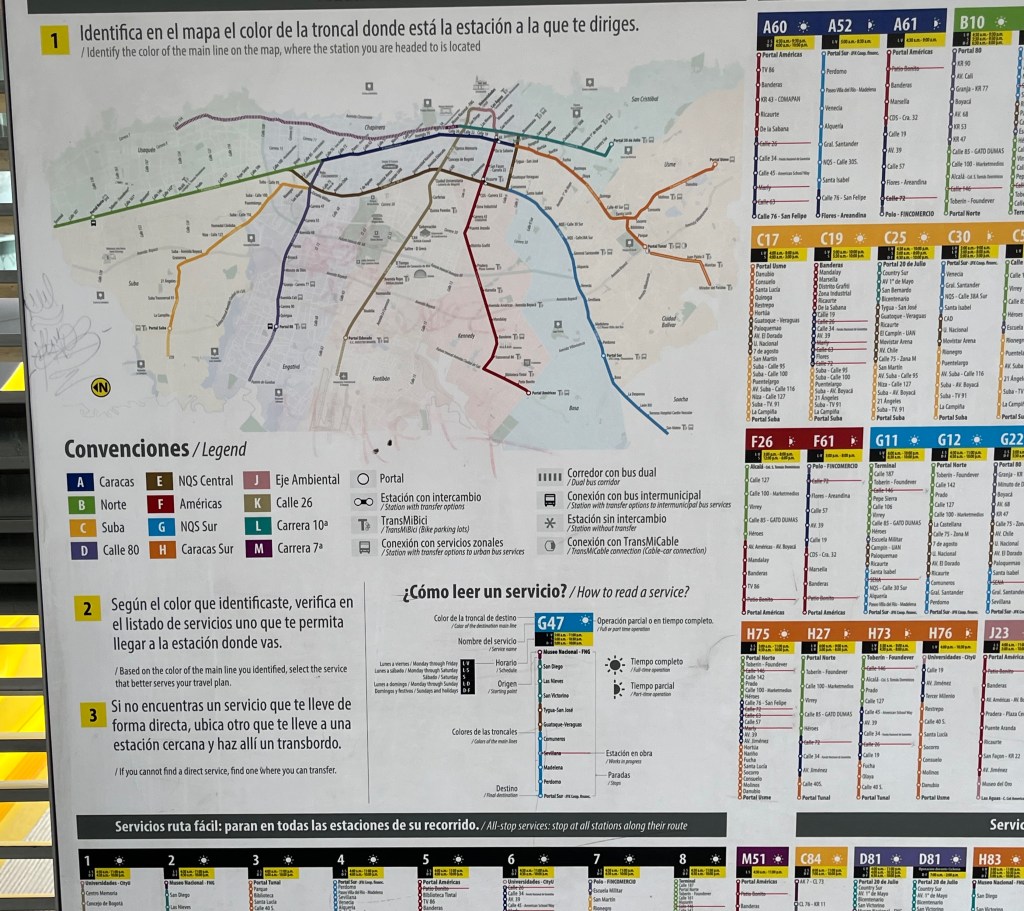
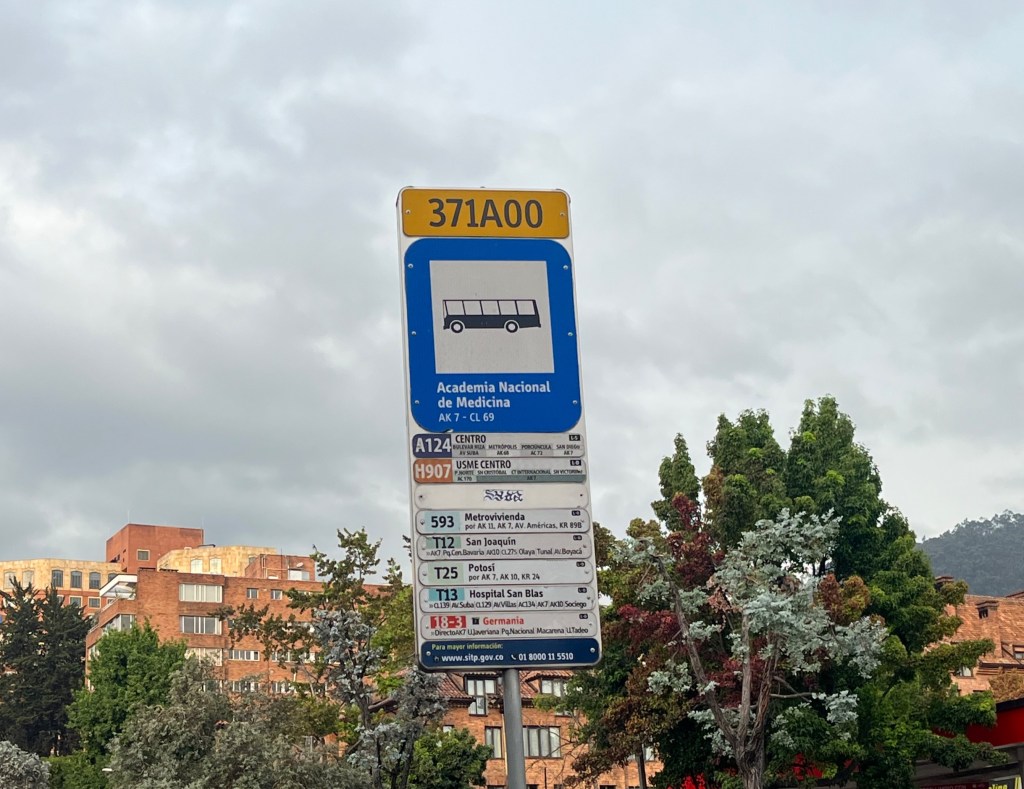
In the photo above, readers will note that certain letters correspond to specific portals or areas in the city. As an example, if you want to get to Suba, you need to eventually connect with buses that have a route number that starts with C. The confusing part of this system is while the portal letter doesn’t change depending on the cardinal direction one is going, the number, however, will change. Sticking with the Suba example: C27 will take you from Portal Usme in the east to Portal Suba in the west. However, if you want to go from Portal Suba in the west to Portal Usme in the east, you need a different C-bus.
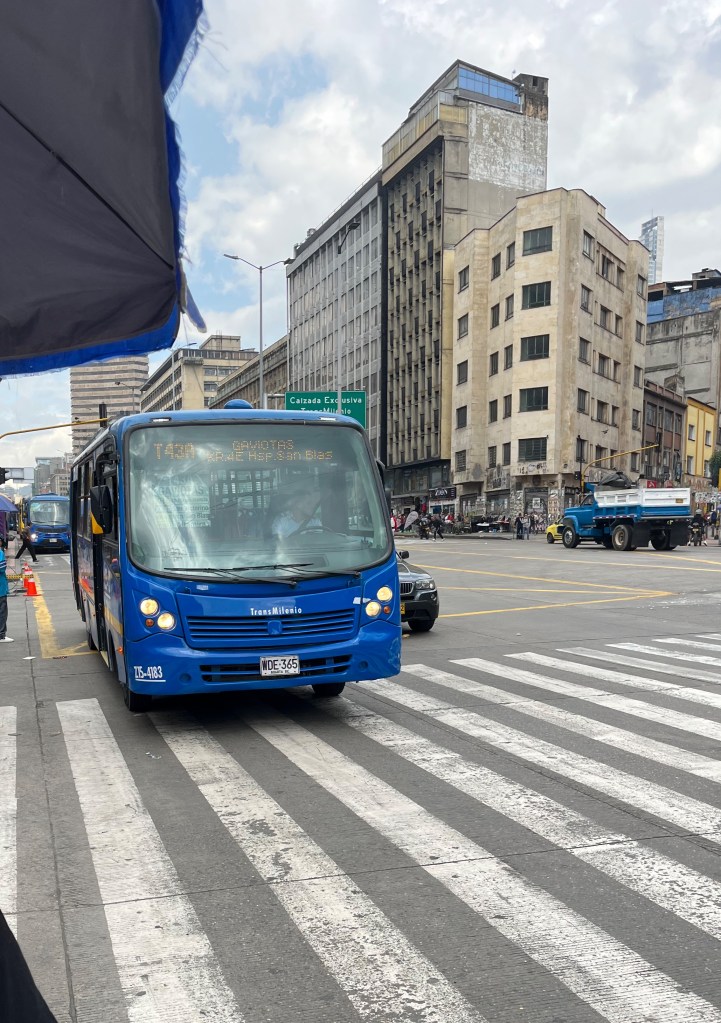
The TransMilenio has three types of buses. First, trunk buses are red and can carry up to 270 passengers. These buses utilize bus-only lanes since they only stop at major stations between portals. Next are feeder service buses that are green and can hold up to 90 passengers. These buses stop at both major and intermediate stops between portals to help bridge gaps. They use both regular traffic lanes and the specialized bus lanes. Lastly, zonal buses are blue, carry up to 30 passengers, and are the least fuel-efficient since they use diesel instead of natural gas. Zonal buses never utilize the specialized bus lanes and are designed to help get people to stops that are not considered major or intermediate. These buses are for folks who need to go only one or two stops away from a major station but that other buses would not stop at. Below is a photo of a zonal bus on a busy Bogotá roadway.
Given that BRTs are designed to speed up the process of transport, the TransMilenio has many ways to accelerate getting people on the bus to their destinations. A rechargeable card is available for purchase at any major station and all three bus types accept this card. If someone is meeting a trunk or feeder bus in a major station, they only need to scan their card to enter the station. This means that a person can ride buses all day long with only paying one fare if they do not exit a station. On the other hand, if someone meets a feeder or zonal bus at a street stop, they must scan their card to a card reader inside the doors and only then can they pass through the turnstile in the bus. This allows for the elimination of the driver having to fumble with change or worry that not everyone has paid their fare. Moreover, every bus type automatically stops at every stop on their route without passengers having to ring a bell. This means that no one has to yell at a driver for not stopping and makes it easier to count stops to your destination.
Yahm and I found it incredibly easy to purchase a card. (By the way, multiple people can use the same card if they wish.) The only caveat is that purchasing the card and fares can only be done in cash. There is an app that lets people recharge their bus card with a credit card. Unfortunately, this option is only possible for people with a Colombian ID. The card itself costs 7,000 COP ($1.80) and each ride costs 2,300 COP ($0.60) making it very affordable for the average Colombian or tourist.
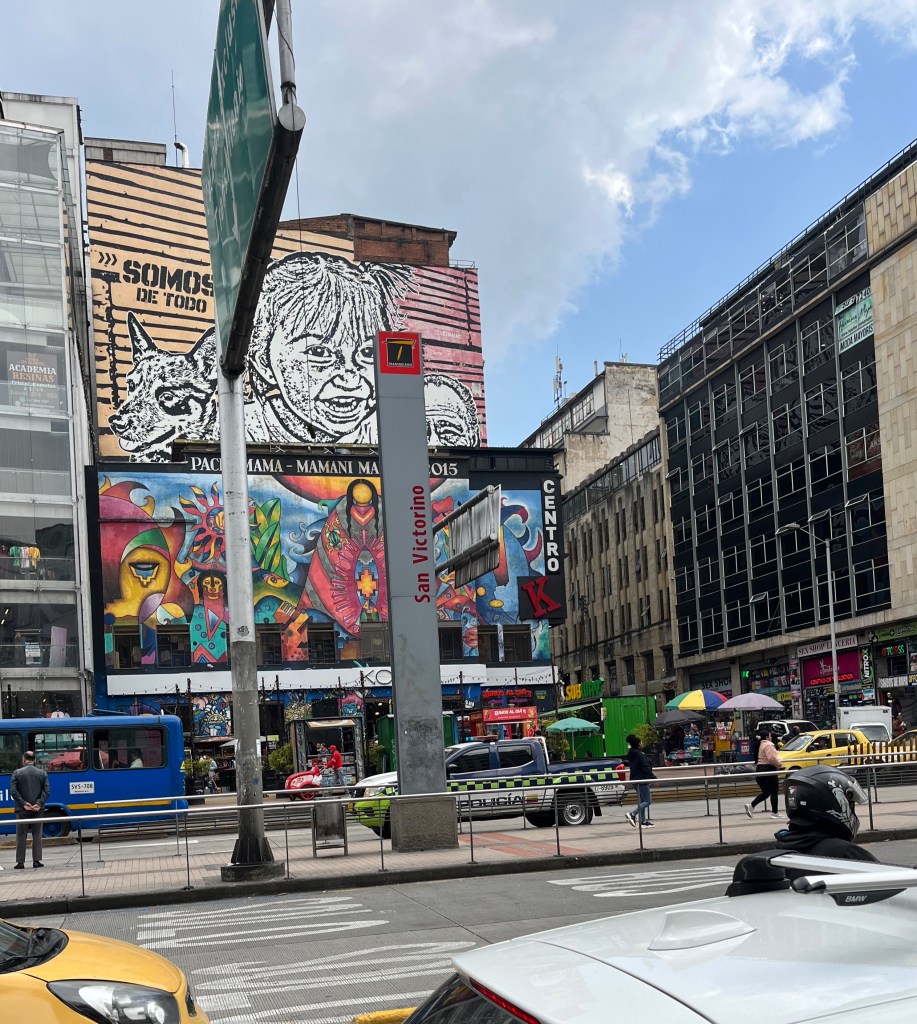
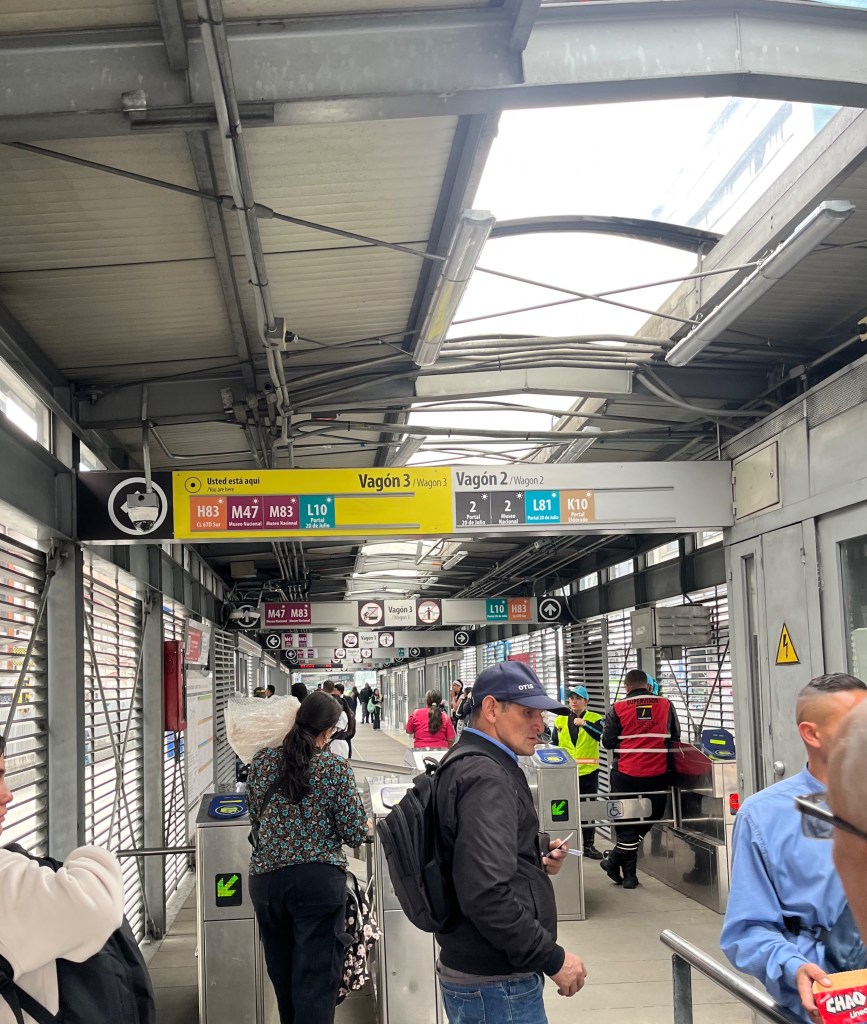
Below are a few photos to help illustrate how efficient this bus system is. On the left is a photo of a major station indicated by the tall rectangular sign in the middle of the roadway. (The station is in the middle of the road.) The center photo is of the inside of the same station with signs indicating where to meet specific routes. Buses stop at automatic doors allowing you to queue by said doors and enter your bus as soon as it pulls up. On the right is a photo of a street bus stop that zonal and feeder buses utilize.
Below is a video of a trunk bus arriving at a station.
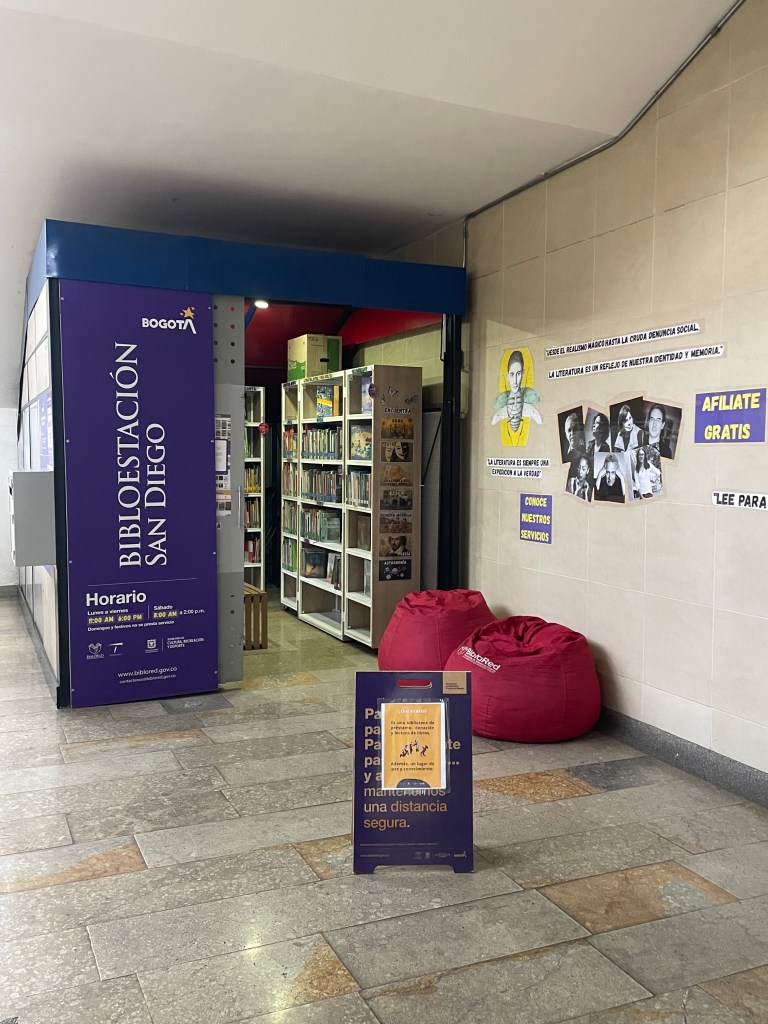
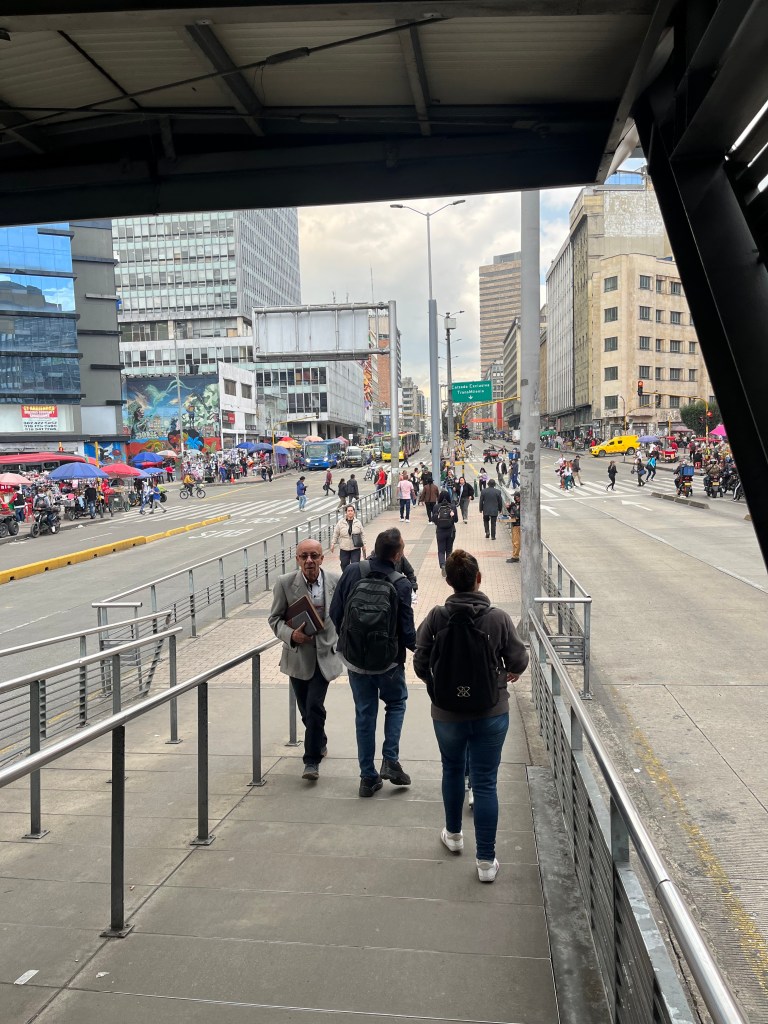
The photo on the left is of a library inside a major station. These libraries are for the public and made Yahm’s heart sing. The center photo is the entrance/exit to a major station from inside the station. On the right is a photo of the inside of a trunk bus.

Below is a video of the city going by from inside a feeder bus.
Stay tuned for our next adventure in the serene town of Salento. Be sure to like, comment, and subscribe to Traveling While Introverted so you don’t miss it!

 Traveling While Introverted
Leave a comment